This Week’s Thought

By Brad Campbell – Just a thought to help start your week.

The old year of 2025 is fading into the past while the new year of 2026 is just becoming clear on the horizon.  I’ve always thought it was very interesting that as much as we think of one year disappearing and another one being a brand new start, there is not a lot of difference between the two.  We arrive on January 1 each year to find it to be very much like the day before, December 31 of the past year.  A different year, yes, but only seconds apart.

I do like the thought that a new year can bring opportunities for us to do something different and perhaps more importantly to be something different.  That thought itself seems to bring some hope in that I don’t have to give up.  I really can be different – in a good way – in the coming year.

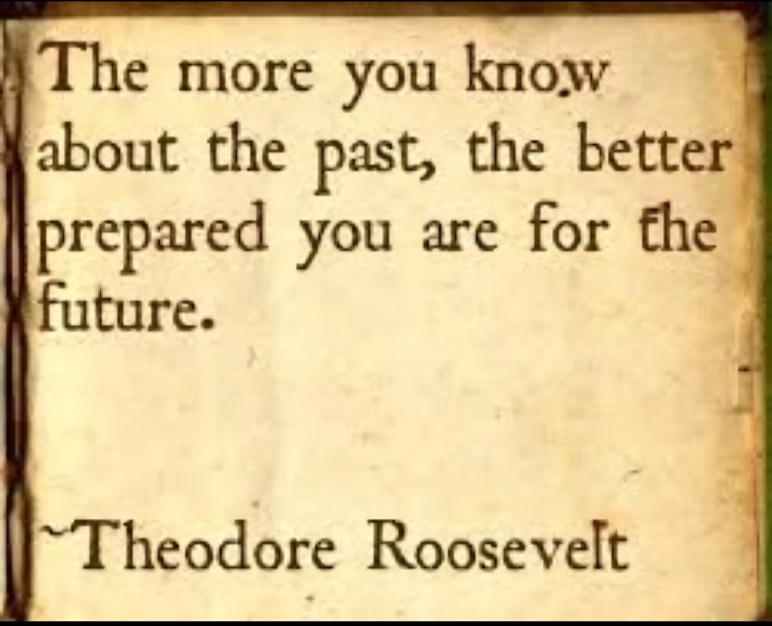
For many people, our family included, the new year begins without several family members who began last year with us.  There are holes that cannot be filled, places that cannot be taken, people that cannot be replaced.  We hesitate to go forward because we are spending an awful lot of time looking in the rearview mirror.  I took a picture of this little sign this past summer in a place I no longer remember.  The quote, attributed to Theodore Roosevelt, says, “The more you know about the past, the better prepared you are for the future.”

Simply put, I know the past to have been difficult, lonely, sorrowful, and full of mourning.  However, I also know the past to have been glorious, bright, inviting, full of adventures, and very much a learning experience.  All of those things can prepare me for the future of this next year.  There will be difficult days, and there will be wonderful days.  There will be hard times, and there will be great times.  There will be losses, but thank God, there is always the glorious possibility of new gains and gifts from Above.

Take time to reflect upon the past – upon 2025 specifically.  For what things and in what ways are you better prepared for 2026 now?  God is always good.  Every day is a good day.  As God leads you from one year into the next, and even from one month, week, and day, and moment into the next, reflect on His goodness and grace and thank Him in advance for all that He has in store for you in the coming year!

Just a thought.

This Week’s Thought

By Brad Campbell –

Just a thought to help start your week.

Disclaimer first – Some of you are reading this on Thanksgiving week.  Some will be reading it later.  Regardless, we are to be thankful all year.

The road you see pictured here is just an old country road.  Because we know what lies beyond those hills and curves, we know that a road was in existence here at least as far back as the very early 1800’s – more than 200 years ago.  This particular road winds its way through the deep woods of the county in which we live.  It climbs hills, overlooks extremely deep ravines, crosses creek beds, and provides a means of access to some prime hunting lands.

This road also happens to be the very road upon which my wife’s family have lived for at least four generations now.  I know by looking at this picture exactly where this spot is located on that road, because I’m familiar with the road.

As God’s people, we are called to travel life’s winding road from the moment we first follow the Lord until that last moment when He finally takes us Home.  And along that road, we will encounter many precious memories, people, and places.  Because we live it, we will remember specific spots along that road that will forever remain special in our hearts.

Thanksgiving and Christmas bring with them a renewed opportunity to be verbally thankful for anything and everything along life’s journey.  God has been so very good to us along the way.  And, He will continue to be just as good for the rest of our travels.  We will always have many things for which to be thankful.

In this week’s sermon, I, as many other pastors did, I’m sure, reminded us not just to be thankful, but to tell the Lord just how thankful we are.  Give Him the praise, honor, and glory that He so richly deserves, not just at this time of year, but all year through — all along our road.

And, as I reminded us, in the story of the 10 lepers that Jesus healed one day, only one of those men came back to say, “Thank you.”  In your holiday celebrations, in your excitement and chaos, in your family gatherings or just quiet little times along the road, if there is to be only 1 in your crowd to voice thanks to the Lord this year, then be that one!

I’m thankful for you.

Just a thought.

American Christianity Prior to 1865

By Dan Naylor –

The modern American Republic appears intent upon erasing its history. Some ideological movements actively vilify George Washington and Abraham Lincoln while pushing an aggressive “America Last” agenda. Historians hope for greater historical literacy, but what they see instead is the steady destruction of our shared past. Scholars have a strategic window to encourage historical literacy, or, failing that, to enable a measure of historical accuracy. How? By conducting concise examinations of Early American history using the opportunities afforded by modern social media. Christianity imparted meaning, discipline and comfort to Early Americans. 

What meaning did Christianity contribute to Americans in the period up to 1865? More to the point, what if Christianity had not contributed? What if Early America had rejected faith entirely, opting instead for atheism, the bleak outlook of paganism or an amoral nihilism? Was a French-style revolution ever the preferred path for Americans—with its savage purging of elites, destruction of religious institutions, and the deliberate enthronement of a tyrant? As one of the American Revolution’s foremost thinkers, Thomas Paine consistently references God and the Bible in “Common Sense” and his many other works , presenting Christian ideas through a lens of reason and common logic. George Washington, in contrast to the wild leaders of most rebellions, oversaw a revolutionary victory and relatively peaceful presidency. He followed this with an astonishing peaceful transition in 1797. The same year he passed away, 1799, Napoleon’s coup plunged Europe into the maelstrom of war. Jefferson’s timeless ideals of equality, life, liberty, and the pursuit of happiness will always guide and inspire us. However, these latter concepts are secondary. The Early American nation ultimately rooted its identity in a Christian vision—establishing itself as a republic under God. 

Meaning came alive, however, only through disciplined effort. In the critical early decades of colonial Massachusetts, Increase Mather and the Governor and Council attributed the catastrophic King Philip’s War (1675–1678) to the failings of Christians in Mather’s colony. This strategy may be interpreted as a deliberate attempt to impose discipline upon Mather’s flock. Though such measures may strike modern sensibilities as cruel and severe, they must be weighed alongside Mather’s acts of generosity, including his fundraising initiatives and his care for the impoverished members of his congregation. The colonists won the war, as they had so fervently prayed. As Puritan influence waned, the Great Awakenings of 1730–1755 and 1790–1840 came to be seen as times of intense spiritual fervor that seemed anything but disciplined. Yet the Great Awakenings were also times of profound discipline and church growth. The dramatic conversion of so many was followed by the yeoman work of faithful friends, relatives, spiritual fathers, and mentors who, empowered by love and by the gifts of the Holy Spirit, guided converts into true discipleship.

An objective examination of Christianity in the early American Republic would be stripped of its meaning and discipline without the sustaining and deeply emotional solace of faith in Jesus Christ. One may focus upon the politics of Early America, its military history and its westward development. And yet, how can one turn a blind eye to the everyday suffering borne by so many, or to the crushing weight of slavery that persisted for generations? Cotton Mather himself penned the The Nightingale: An Essay on Songs Among Thorns, or, The Supports and Comforts of the Afflicted Believer. This may mean little to a reader unaware of the sorrow which bore heavily on Mather, who lost thirteen of his fifteen children during his lifetime, and his wives Abigail (1702) and Elizabeth (1713). If there could be worse tragedies, among the most devastating was the loss of husbands and sons in brutal conflict. Well known is Henry Wadsworth Longfellow’s heartrending “I Heard the Bells on Christmas Day”, written after he had rushed to be with his severely wounded son. Sadly, this was an all-too-common occurrence in America’s Civil War. Connecting with Early Americans is no easy task, yet by witnessing their living faith in an eternal, loving God, one may catch a fleeting glimpse of the hope that sustained them.

The moment invites historians to cultivate within our communities and beyond a renewed awareness of the Christian meaning of the American Republic. May we also recognize the need for a holy life that reflects the discipline of our fathers. Might we enjoy the comfort of the Holy Spirit, always with us in trouble. 

“Blessed be God, even the Father of our Lord Jesus Christ, the Father of mercies, and the God of all comfort; Who comforteth us in all our tribulation, that we may be able to comfort them which are in any trouble, by the comfort wherewith we ourselves are comforted of God.”
2 Corinthians 1:3–4

This Week’s Thought

By Brad Campbell –

Just a thought to help start your week.

I’ll start out this week by asking you some questions.  Have you been having a tough time lately?  Are you struggling to make ends meet?  Does it seem like you are bearing the weight of the world upon your shoulders?  Has it been easier to cry than to smile?  Are you just feeling a little run down, or down and out?

I’m no psychologist or psychiatrist.  What I am is a pastor who also happens to be a human being.  And I can tell you that I understand.

I snapped this picture in New Haven, Connecticut a year or so ago as Youngest Daughter and I walked around.  This sculpture sits in the front yard of their public library.  One young person is reading while another is relaxing with her head on the lap of the first.  Not a care in the world.  Just reading and resting.  Enjoying the sunshine and the beautiful weather.  We look at poses similar to these and think about how nice it would be to just lay it all down, ignore the distresses and problems, take a few minutes to just read, listen to the quiet, and take a very long deep breath of air.

It’s easier than you think.  Look of it this way.  What’s easier – carrying around a heavy load of anything, or laying it down?  What’s easier – worrying about anything and everything, or focusing on praying to the One Who can take care of it?  What’s easier – struggling day in and day out to try and accomplish it all on our own, or looking to the Lord for His strength which will carry us through any storm?  Do you get my point?

We say, “I can’t give it up.  I can’t turn it loose.  I have too much responsibility.  I need to be everything for everybody.”  Respectfully, no you do not.  And the sooner you realize that, the lighter your load will be!  Any of us can spare a moment.  Trust me.  So take that one moment this week.  Sit down.  Stay there.  Read something, or don’t.  But leave the burdens, disappointments, and responsibilities alone for a bit.  Take in a long deep breath of God-given Holy Spirit breathed air from above.  Turn it all over to Him – again!  And listen to the silence of your own breath.  If you plan to do all you have to do, you must have strength to get it done.  And you can only get the strength you need from God the Father.  Give Him your cares.  He is no psychologist or psychiatrist either.  He’s a God Who knows and understands your needs and your heart.  

Lay your head in the Father’s lap and let Him take care of you.

Just a thought.

Another Great Awakening in America

By Ryan Kelly –

Revival has always stirred my heart. For as long as I can remember, I have prayed for it, studied its history, and longed to see it unfold in our time. The late Rev. Billy Graham once said that America had “one more great revival in her,” and I know many friends who would echo those words with conviction. Today, I find myself wondering—are we witnessing the birth of that long-awaited revival?

Throughout our nation’s history, God has moved in powerful ways, often marked by what scholars call the “Great Awakenings.” The First Great Awakening (1730s–1740s) was led by voices like Jonathan Edwards and George Whitefield, calling people to heartfelt faith and personal conversion. The Second Great Awakening (1790s–1840s), ignited by leaders such as Charles Finney, brought multitudes to Christ and propelled major social reforms, from abolition to women’s rights. The Third Great Awakening (1850s–early 1900s) saw prayer movements in New York and evangelists like Dwight L. Moody expand the Gospel alongside a wave of missionary outreach. Some even point to the Fourth Great Awakening (1960s–1970s), shaped by the Jesus Movement, contemporary Christian music, and a renewed emphasis on personal relationship with Christ.

In our own day, we’ve seen the passing of giants, Billy Graham, John MacArthur, Tim Keller, and others, leaving behind a profound legacy. Their absence has created a void, but one that is now being filled by a new generation of passionate preachers and teachers. And in recent days, the tragic assassination of Charlie Kirk in Utah has become a spark on dry ground. What the enemy intended for harm, God is already using to fan the flames of revival.

Just this past weekend, reports emerged of tens of thousands of unbelievers walking into church for the very first time. Tens of thousands more opened their Bibles, heard the Gospel, and encountered the hope of Christ. Charlie Kirk’s funeral drew more viewers than the Super Bowl, both in person and through broadcast, and nearly every tribute flooding social media points not to politics, but to his unwavering faith, his love for family, and his devotion to Jesus.

Time will tell how history records this moment, but I truly believe we are standing in the early days of a new Great Awakening, one that could sweep across America and perhaps the world. My challenge to you is simple: be part of it. Share Christ with others, live for Him daily, and die to self so that He may shine through you.

As the Apostle Paul wrote: “For to me, to live is Christ and to die is gain.” (Philippians 1:21)

Against the Wind

By Ryan Kelly –

Have you ever wondered why our journey toward growth in righteousness is rarely smooth or easy? If following Christ means walking in His peace, shouldn’t the road be free of obstacles? Yet, time and again, we find that the opposite is true. The Christian life is filled with challenges, setbacks, and trials that test our faith and force us to lean on the Lord more deeply.

I recently came across a quote from Henry Ford that struck me: “Remember that the airplane takes off against the wind, not with it.” That simple observation carries a profound truth. Just as airplanes need resistance to rise, we too need opposition and difficulty to grow in our faith. Without the wind pressing against us, we would never gain the lift that brings us closer to God.

This idea reminds me of fitness analogies. When you go to the gym, if you never push your muscles beyond their comfort zone, you won’t build strength. Growth only comes through resistance, strain, and perseverance. The same is true of our spiritual lives. If our journey with Christ were always smooth and effortless, we would never develop endurance, never cultivate true hope, and never learn to depend on God’s strength rather than our own.

Scripture affirms this truth over and over. Paul exhorts Timothy: “But you, man of God, flee from all this, and pursue righteousness, godliness, faith, love, endurance, and gentleness” (1 Timothy 6:11). Notice the word pursue. It implies effort, determination, and pressing forward even when the way is hard. Peter echoes this when he writes: “These have come so that the proven genuineness of your faith—of greater worth than gold, which perishes even though refined by fire—may result in praise, glory and honor when Jesus Christ is revealed” (1 Peter 1:7). Our trials refine us like fire purifies gold, stripping away impurities and revealing the priceless treasure of a faith that truly trusts in Jesus.

And Jesus Himself gives us both warning and comfort in John 16:33: “I have said these things to you, that in me you may have peace. In the world you will have tribulation. But take heart; I have overcome the world.” He doesn’t promise a trial-free life, but He does promise His peace and His victory. Our struggles are real, but they are never final, because Christ has already won.

So when the winds of hardship press against you, remember: they are not there to destroy you but to lift you higher. Just as the airplane rises against the wind, your faith can soar when you lean fully on God in seasons of resistance. The hard road is the refining road. It is the place where perseverance takes root, hope blossoms, and reliance on the Lord deepens.

Take heart today, friend. The winds may be strong, but they are carrying you closer to the heart of God.

Revival is Here!

By Ryan Kelly –

Across the nation, the Spirit of God is moving in ways we’ve long prayed for. Quietly at first, and now with a roar that cannot be ignored, people are placing their faith in Christ and are making public professions through Baptism and genuine life change.

In recent months, from the coastal waters of California to the heartland of Kentucky, tens of thousands have gathered in worship, surrender, and baptism. Whether in Rupp Arena where 8,000 students cried out to God, or on the beaches of California where waves of souls were baptized, we are witnessing not just isolated events but a divine pattern—an unmistakable spiritual awakening. These are fresh outpourings birthed from hunger, humility, and a holy desperation.

God is not just stirring in church pews, He’s taking center stage in places we once thought unreachable. Revival is leaking into the fabric of pop culture, with athletes publicly giving glory to Jesus in post-game interviews, musicians turning stages into pulpits, and influencers boldly proclaiming Christ to their millions of followers. The Holy Spirit is moving in locker rooms, studios, red carpets, and press rooms. What once seemed radical is now becoming a revival rhythm: Jesus is being lifted high in public and popular spaces, breaking the mold of what cultural faith has looked like in America.

Even in politics and government, we see glimpses of transformation. Elected officials are boldly praying in chambers, quoting Scripture in speeches, and standing for biblical values with unshaken resolve. And perhaps even more powerful are the quiet, personal revivals happening in everyday lives. Single moms, students, blue-collar workers, retirees and people of every background and burden are being set free and finding purpose in Christ. It’s as though God is sweeping across the nation, reminding us that no person, no place, and no institution is beyond His reach.

What we are witnessing is not a passing trend, rather it is the answer to generations of prayer. Revival is not only possible…it is happening today.

Let us not simply be spectators. Let us be surrendered vessels, ready to be a radiant reflection of the light and love of Jesus wherever we go. For the same God who is moving in arenas and oceans is also knocking at the door of our hearts. May we open wide and let Him in. Amen.

The Name of Jesus and 2024 American Politics

By Ryan Kelly –

This is a tough article to write, an even tougher to keep succinct. There is a huge political rift in the United States today, which has been building for more than 20 years on hot-button topics including taxes, foreign wars, immigration, nationalism, race, and abortion.

Some of these topics I believe have easy stances to take as a Christian, while others are very obscure and specific to details. For instance, is it more Christ-like to allow those in need to come into our country with public support to build a better life, or is it more important to place controls over immigration and focus on American citizens who have critical needs first? Is it Christ-like to have an America-first agenda and support jobs and pride in our nation, or is it better to have a global focus and share our resource with other nations and people groups? We could go days debating these topics, and I’m sure I could support elements of both sides.

Today we have two candidates for president that are unique. Donald Trump and J.D. Vance have an America-first agenda with limitations of taxes, reduced immigration allowances, a reduction in foreign spending, tariffs on foreign goods, and state’s rights when it comes to abortion. Kamala Harris and Tim Walz are almost the exact opposite, with a largely globalized agenda, focus on increased taxes and government spending, global trade, increased support and involvement in Ukraine, and legalized national abortion.

Based on this alone without further detail (with one exception), I could not tell you which set of candidates are more Christ-like on the surface with respect to policy and advancing our country.

What does have a very clear and distinct right and wrong for me is with the name of Jesus and the declaration of His Lordship in the public arena. For me, this is what makes the difference.

Two weeks ago, two students from the University of Wisconsin La-Crosse, Luke Polaske and Grant Beth, attended a Harris Walz rally at their campus and made a peaceful protest in support of the elimination of abortion.

Beth was quoted as remarking about his experience, “I was pushed by an elderly woman. We were heckled at, we were cursed at, we were mocked, and that’s the biggest thing for me personally. In reflection of the event, Jesus was mocked. You know, his disciples were mocked, and that’s okay. In reality, we did God’s work, and we were there for the right reasons, and God is watching us in this moment.”

The moment that made headlines what when one of the students shouted out “Chris is Lord and Jesus is King.” Kamala Harris laughed and then remarked, “You guys are at the wrong rally,” and then waved to them both to leave. This is in reference to another rally taking place across town with Donald Trump and JD Vance, implying that those values are not shared at the DNC rally but rather at the one hosted by the GOP.

Flash forward to two weeks later where JD Vance hosted a rally in Waukesha, Wisconsin. At this rally, Vance remarked about his deep faith in Christ and how this relationship with our Lord has shaped him into the man that he is today. During these remarks, an attendee shouted the exact same statement, “Jesus is King” and Vance paused and acknowledged that “Indeed, Jesus is King” and then went on to describe the importance of his faith and how this is needed in our nation.

Of the four candidates, Harris has asked for prayer on occasion and has appealed to members of historically black churches, yet has never publicly discussed her faith or religious beliefs. Tim Walz has described himself as a Lutheran, but again, has given very little detail as to his faith. Donald Trump describes himself as a Presbyterian and has frequently discussed his faith in God and the work of God in his life, especially with respect to the recent assassination attempt in Pennsylvania. J.D. Vance has been by far the most vocal with regard to his faith, going into great detail about his salvation through Christ, his baptism, and how this shapes his personal and political life.

I do not know the hearts of any of these four people. All four may have saving faith through Jesus or all four may be lost souls in need of a savior. I do not know. What I do know is that one side clearly stands for Jesus in a public way and supports values that are clearly Biblical. On the contrary, one side seems to actively avoid the name of Jesus and do whatever they can to adopt what is now referred to as a secular humanist philosophy.

I believe that we as Christians must vote in a way that will best glorify God and will best represent what He wants in this world. I don’t vote for people, I vote for policies. I don’t vote for parties, I vote for what will best represent my values and desired outcomes as a man who attempts to be a reflection of Jesus in this world.

I hope that you do the same as you consider who you will cast your vote for on November 5th. If you do not know who to vote for, I encourage you to pray that the Lord will reveal this to you and open your heart to what He is telling you. Then, vote with confidence that you are doing what the Lord desires of you, whatever that answer is. For me, the answer is easy. I pray that it is for you as well.